
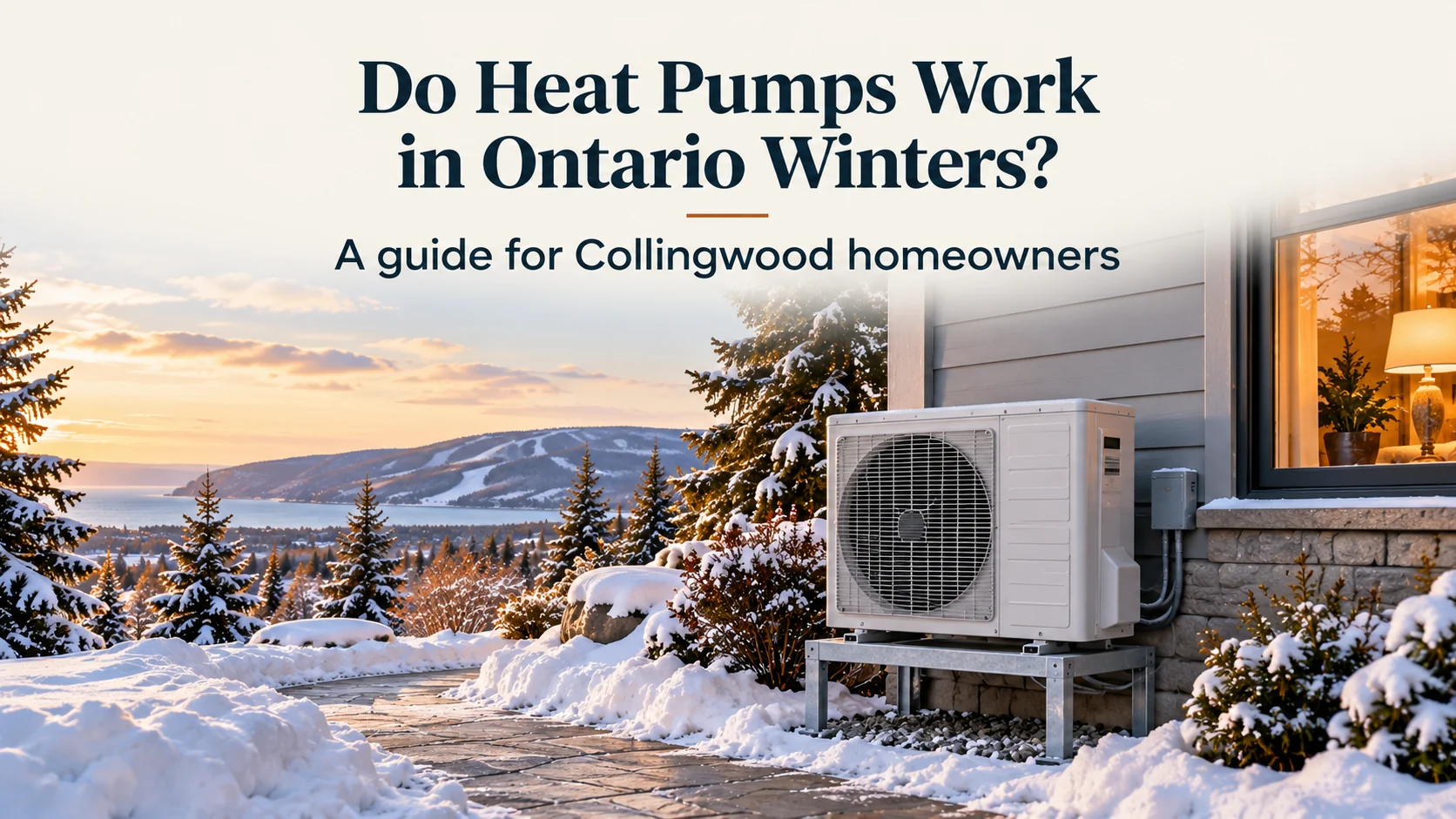
Yes. A properly selected cold-climate heat pump can provide reliable heating through Ontario winters. Some models continue producing heat at −25°C, −30°C or lower. Whether a particular system can keep your entire home warm without additional heat depends on the equipment, the weather and how much heat your home loses.[1][2]
For homeowners in Collingwood and the surrounding area, that distinction matters. You want to know whether the bedrooms will stay comfortable during a cold snap, what happens after a snowfall and whether you should keep your furnace.
The best starting point is to look at the heat pump and your home together. A temperature printed on a brochure is only part of the answer.
How can a heat pump heat your home when it is freezing outside?
Outdoor air still contains usable heat below freezing. An air-source heat pump collects that heat using refrigerant, raises its temperature through compression and transfers it indoors. During summer, it reverses the process to cool your home.[1]
Cold-climate equipment is designed specifically for low outdoor temperatures. Many systems use variable-speed compressors that adjust their output as the heating demand changes. However, cold-weather performance varies between models, including models sold by the same manufacturer.[2]
This article focuses on air-source systems, including centrally ducted heat pumps and ductless mini-splits. Ground-source systems use a different heat source and require a separate assessment.
How cold is too cold for a heat pump?
There is no single outdoor temperature at which every heat pump stops working. The exact equipment combination has an operating range, and its heating output changes with outdoor conditions.[2][4]
Three measurements help explain the difference:
| Measurement | What it tells you | What to ask your installer |
|---|---|---|
| Minimum operating temperature | The low-temperature limit at which the manufacturer permits the heat pump to operate. | What happens when the outdoor temperature reaches that limit? |
| Heating capacity | How much heat the system can supply at a particular outdoor temperature. | How does that output compare with my home's heating demand on cold days? |
| Coefficient of performance, or COP | The heat delivered compared with the electricity consumed at specified conditions. | What is the COP at relevant winter temperatures, rather than only in mild weather? |
For example, a COP of 2 means the heat pump delivers two units of heat for each unit of electricity it uses at that operating condition. It does not mean the system maintains that efficiency throughout winter.[3][4]
What does the cold-climate label mean?
ENERGY STAR’s cold-climate criteria include a COP of at least 1.75 at −15°C and heating capacity at that temperature of at least 70% of the capacity measured at about 8°C, under the specified tests.[3]
That is a useful screening standard. It does not establish that every certified model will meet every home’s heating needs at −25°C. Ask to see the low-temperature performance data for the proposed indoor and outdoor units together.
What makes a heat pump suitable for a Collingwood home?
A home in central Collingwood, a Wasaga Beach cottage and a chalet in The Blue Mountains can have very different heating needs. Floor area alone cannot tell you which heat pump will work best.
Start with a heat-loss calculation
A proper assessment considers insulation, windows, air leakage, the building’s surfaces and the rooms being heated. It should use outdoor design conditions appropriate to the location, rather than a provincial winter average. These conditions help establish the heating capacity needed during cold weather.[6]
Ask for a documented calculation using an appropriate Canadian method, such as CSA F280, and an explanation of how the proposed system meets that load. Simply matching the size of the old furnace can carry an earlier sizing problem into the new installation.[7]
Bigger is not automatically better
An undersized system may depend more heavily on supplemental heat than intended. Oversizing can cause excessive cycling and poorer summer humidity control. Variable-speed equipment helps adjust output, but it still needs to be selected for the home’s heating and cooling requirements.[5]
Check the house and the airflow
An older home is not automatically unsuitable. Addressing significant drafts, missing insulation or disconnected ducts can reduce heat loss and improve comfort before the equipment is selected.[6]
For a central system, the installer should also check supply ducts, return airflow and the condition of the existing distribution system. If some rooms already struggle to stay warm, include those concerns in a ductwork installation and repair assessment. Replacing the outdoor equipment alone may not resolve them.[7]
Will you still need a furnace or backup heat?
Possibly, but backup heat does not have to mean a gas furnace. The appropriate arrangement depends on the home’s heat loss, the heat pump’s output and the intended control strategy.
The thermal balance point is the outdoor temperature at which the heat pump’s available output matches the home’s heating demand. Below that point, additional heat may be needed even though the heat pump can still run. A system’s programmed changeover temperature may also reflect equipment limits or the chosen operating strategy.[4]
A heat pump paired with a furnace
A hybrid or dual-fuel arrangement uses an electric heat pump alongside a fuel-burning furnace. Controls determine when each operates. This can be worth discussing if you want to retain a suitable furnace while adding heat-pump heating and summer cooling.[1]
Ask the installer to explain the proposed changeover settings and confirm equipment compatibility. There is no universal setting that should be copied from another homeowner’s system.
For the broader equipment comparison, read Heat Pump vs. Furnace for a Collingwood Home.
An all-electric heating system
An all-electric installation may combine a cold-climate heat pump with electric resistance heating, such as an air-handler heat kit or retained baseboards. These can supply additional heat when required. Their capacity and controls should be part of the design; they should not be assumed to be small or rarely used.[4][10]
Before installation, have the home’s electrical capacity assessed for both the heat pump and any supplemental heating.[7]
A ductless system for selected spaces
A cold-climate mini-split can heat an addition, a cottage living area or a room that the main system does not serve well. Whole-home ductless heating is also possible, but the layout and room coverage need careful planning. One head in an open living room should not be assumed to heat closed bedrooms adequately.[8]
Our ductless heating and cooling service page explains these options. For properties used intermittently, see Ductless Heating and Cooling for Cottages and Additions.
Snow and installation location matter, too
When discussing a Collingwood-area installation, walk around the property with the installer. Point out where snow drifts collect, where the driveway is cleared and where water falls from the roof. These details help identify a practical outdoor-unit location.
The unit should sit above anticipated snow accumulation, with the clearances required by its manufacturer. Defrost water also needs somewhere to drain without creating a frozen obstruction or an icy walking surface.[7]
Roof runoff, service access and unobstructed airflow deserve attention. A tight decorative enclosure can interfere with the air the heat pump needs.[8]
During winter, keep drifting or shovelled snow from blocking the unit. Ask your installer which snow-protection accessories, if any, suit the equipment and location.
What is normal during winter operation?
Longer heating cycles
A variable-speed heat pump can operate for long periods while adjusting its output to match demand. Runtime alone is not a useful verdict on performance. Pay attention to whether the house maintains the intended temperature and whether the system behaves as the installer explained.[5]
Frost, defrost cycles and a brief cloud of vapour
Moisture can freeze on the outdoor coil during cold, humid weather. The heat pump periodically reverses its cycle to clear that frost. You may notice a change in sound, the outdoor fan stopping briefly or a cloud of water vapour as the frost melts. Depending on the system, supplemental heat may operate during defrost.[9]
Persistent or growing ice, repeated loss of heat or unusual mechanical noises warrant professional attention. A unit that cannot clear its frost is different from one completing an ordinary defrost cycle.[12]
If the home is getting colder or the equipment is behaving abnormally, request heat pump repair in Collingwood.
The thermostat displays “AUX”
“AUX” generally means the controls have called for supplemental heat. It can appear during cold weather, temperature recovery or defrost, depending on the system. Seeing it occasionally does not establish that something is wrong.
“Emergency Heat” is a different setting on systems that provide it. It typically disables the heat pump and relies on backup heating. It is not a winter efficiency setting; use it according to the equipment instructions and professional guidance.[10]
How to help your heat pump perform well through winter
These habits support reliable operation:
- Use the recommended thermostat strategy. A steady, comfortable setting is often appropriate. Ask before introducing large overnight setbacks, particularly if recovery could trigger supplemental heat.
- Keep filters clean. Follow the instructions for the installed filter type; cleaning and replacement needs vary.
- Keep airflow clear. Avoid blocking indoor units or registers with furniture and outdoor units with shrubs, debris or snow.
- Arrange professional maintenance. Follow the manufacturer’s service recommendations and deal with unresolved issues before prolonged cold weather.[10][11]
If you plan to change controls, discuss compatibility through our smart thermostat installation page. A new thermostat should support the equipment and its heating strategy.
For seasonal servicing, see heat pump maintenance in Collingwood and our guide to preparing your Collingwood home’s HVAC for winter.
Questions homeowners often ask
Can a heat pump replace a furnace completely?
Yes, in a properly designed installation. The decision should account for the full heating load, low-temperature output and heat distribution throughout the home. Some systems include electric supplemental heat, so an all-electric home is not necessarily relying on the compressor alone.[6]
Does “works at −30°C” mean no backup is needed?
No. It describes a capability of particular equipment, not a guarantee for your house. Ask what heating capacity remains at that temperature and how the proposed system covers any shortfall.[2][4]
Will a hybrid system keep heating during a power outage?
Not automatically. Heat pumps need electricity, and a typical forced-air gas furnace also needs electrical power for its controls and blower. Having two heat sources is different from having backup power. Discuss outage arrangements separately.[1][13]
What about a cottage or ski chalet left empty between visits?
Tell the installer how you actually use the property. Ask about temperature recovery, remote monitoring and protection for plumbing in less-heated spaces. Removing or reducing an existing heat source can change conditions in basements or other remote areas.[6][11]
Our HVAC checklist for seasonal homes and ski chalets covers the wider planning considerations.
Choosing winter heating for your home
Before agreeing to an installation, ask for a clear explanation of:
- Your home’s calculated heating requirement.
- The proposed equipment’s output at relevant cold-weather temperatures.
- How each room will receive heat.
- When supplemental heat will operate, if included.
- Outdoor-unit placement, snow clearance and drainage.
- The controls and maintenance instructions you will receive.
For a homeowner in Collingwood, Thornbury, Meaford or elsewhere around South Georgian Bay, those answers are more useful than a broad claim about what heat pumps can or cannot do in Ontario.
Explore heat pump installation and replacement in Collingwood or contact Collingwood Comfort to discuss your home’s layout, existing heating system and winter comfort concerns.
Sources
- Save on Energy / IESO — Air Source Heat Pump Buying Guide
- Mitsubishi Electric Canada — Hyper-Heat cold-climate technology and model-specific operating limits
- ENERGY STAR — Heat Pump Equipment Key Product Criteria
- Natural Resources Canada — Air-Source Heat Pump Sizing and Selection Guide
- Northeast Energy Efficiency Partnerships — Why Sizing Matters in Cold Climates
- Northeast Energy Efficiency Partnerships — Guide to Sizing and Selecting Air-Source Heat Pumps in Cold Climates
- BC Hydro — Heat Pump Retrofit Best Practices Guide for Contractors
- ENERGY STAR — Ductless Heating and Cooling
- Trane — What Is a Heat Pump Defrost Cycle?
- Trane — What Is Auxiliary Heat in a Heat Pump System?
- Efficiency Maine — Heat Pump User Tips
- Trane — Heat Pump Troubleshooting
- Carrier Canada — Furnace Troubleshooting and Electrical Power Checks