
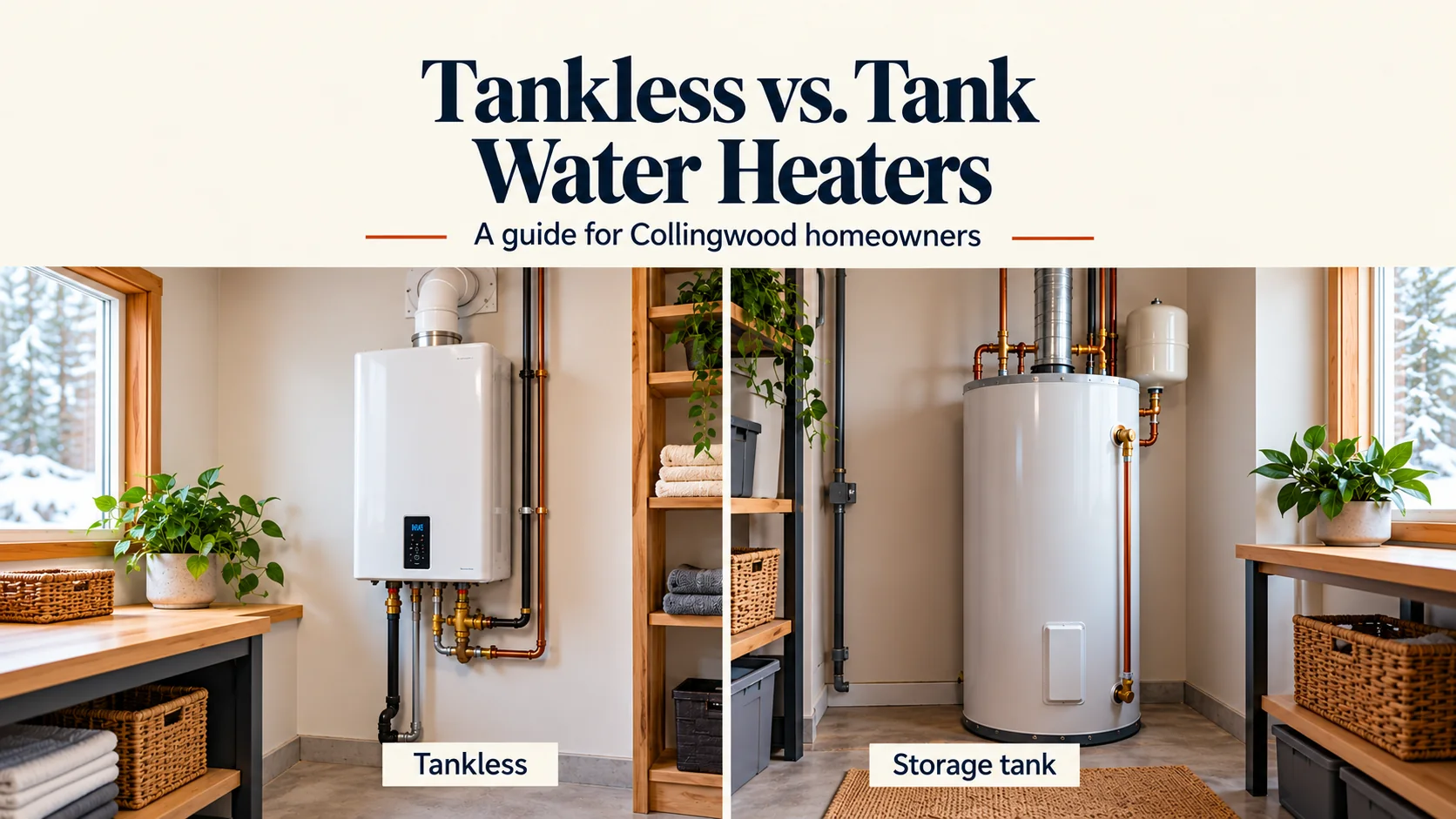
A good water heater should keep up with your household without making you plan the day around hot water. Choosing between tankless and a storage tank comes down to how you use water, the equipment your home can support and the maintenance you are prepared to keep up with.
For homeowners in Collingwood and the surrounding Georgian Bay communities, there is another consideration: performance when incoming water is cold in winter.
Tankless can be a strong choice for consecutive showers and saving floor space. A properly sized storage tank can also serve a busy household well. Neither is automatically the better option for every home.
How tank and tankless water heaters work
A storage tank water heater keeps a supply of heated water ready for use. As hot water leaves, cold water enters and the heater replenishes the supply. It also cycles on when necessary to maintain temperature between uses.
A tankless water heater heats water as it flows through the unit. It does not rely on a large stored reserve, but it can heat only a certain amount of water at once. Both types are available with different energy sources and performance characteristics.[1]
Tankless vs. tank: a quick comparison
| Consideration | Storage tank | Tankless |
|---|---|---|
| Hot water supply | Stored reserve, replenished as the heater recovers | Continuous heating within the unit’s flow capacity |
| Busy periods | Depends on storage capacity and recovery | Depends on simultaneous demand and temperature rise |
| Space | Needs room for the tank and servicing | Usually wall mounted, with required clearances |
| Energy use | Some heat is lost from stored water; technology matters | Avoids heat loss from a large stored reserve |
| Maintenance | Sediment removal and anode inspection where applicable | Descaling and filter cleaning as specified |
| Installation | A similar replacement may suit existing connections | Conversion may require changes to utilities, venting and drainage |
The most useful comparison is between specific models that can meet your household’s needs. A small tank and a high-output tankless unit are not equivalent simply because both heat water.[1, 2, 3, 4, 6, 9]
Which one will keep up with your household?
Start with your busiest period of hot water use. Consider showers, baths, laundry and kitchen use—and which activities happen together.
For example, a family taking four showers one after another has a different requirement from a household running two showers while filling a bathtub. The number of people matters, but the timing matters too.
For a tank, look beyond its size
Tank capacity tells you how much water it holds. Its first-hour rating tells you how much hot water it can deliver during an hour of use, starting with a fully heated tank. That includes stored water and water heated during that period.
Two tanks with similar capacities can have different first-hour ratings. Compare this rating with your busiest hour, rather than assuming a larger tank is always the answer.[3]
For tankless, check flow at winter conditions
Tankless sizing depends on the required flow and temperature rise: the difference between incoming water temperature and the temperature the heater must deliver.
Colder incoming water means more heating is required. A unit’s advertised maximum flow may therefore be higher than it can deliver during winter at your property.
For a Collingwood home, ask the installer to calculate performance using an appropriate winter inlet temperature and your expected simultaneous demand. This is especially relevant if you want several bathrooms to operate together.
Tankless can keep supplying hot water for successive showers, provided the demand stays within its output. It cannot support unlimited showers and appliances at the same time.[4]
Does tankless mean instant hot water?
No. “On demand” describes how the heater operates, not how quickly hot water reaches every tap.
Water already sitting in the pipe between the heater and a distant bathroom must move through before newly heated water arrives. Replacing a tank with tankless does not automatically eliminate that wait.
If waiting at the tap is your main frustration, discuss pipe layout, heater location and a compatible recirculation system. A demand-controlled system can reduce waiting and wasted water. Continuous recirculation can increase energy use through pumping and heat loss from the pipes, so controls matter.[5]
Explore the available options on our tankless water heaters page, including whether the proposed setup addresses your actual hot water problem.
Which type is more energy efficient?
Tankless avoids the heat loss associated with keeping a large reserve of water hot between uses. That can make it more efficient than a conventional storage heater using the same fuel.
However, “tankless” is not a complete efficiency rating. Condensing gas models recover additional heat from combustion gases, while different storage heaters use different insulation and heating technologies.[6]
Compare the actual equipment, fuel and expected household use. A broad percentage from a buying guide is not a prediction of your home’s results.
A heat-pump water heater is also a tank
A heat-pump water heater transfers heat from surrounding air into water stored in a tank. It can use substantially less electricity than a conventional electric-resistance water heater.
This makes it worth considering if you are replacing an electric tank or exploring an all-electric home. The choice is broader than a conventional tank versus tankless.[1]
Its suitability depends on the installation space. An integrated heat-pump water heater needs appropriate air temperature and airflow, condensate drainage, and room for servicing. It also produces fan and compressor noise and cools the surrounding space.
For a Collingwood basement or utility room, have those conditions assessed. An unheated space that falls below the model’s operating range may be unsuitable. This is water-heating equipment, separate from the heat pump used to heat and cool your rooms.[7]
What changes when you replace a tank with tankless?
A smaller appliance does not necessarily mean a simpler installation.
For a gas tankless conversion, the assessment should cover:
- Whether the gas supply can support the appliance alongside other gas equipment.
- A suitable route for combustion air and exhaust.
- Electrical power for the unit’s controls and other components.
- Condensate drainage for a condensing model.
- Plumbing connections, service access and required clearances.
Existing connections should be checked against the selected model’s requirements. A gas line or vent that served the old tank may not suit the replacement.[2, 6]
For a whole-home electric tankless system, electrical capacity can be a deciding factor. Heating flowing water requires substantial instantaneous power. Have an electrician assess the service, panel and required circuits before assuming it is a straightforward swap for an electric tank.[8]
Storage replacements also need proper assessment, particularly when changing fuel, capacity or venting type.
If you are planning water heater installation or replacement in Collingwood, ask for a proposal that explains both the equipment and the changes needed to make it work in your home.
Water quality and maintenance matter for both
Neither option is maintenance-free.
For storage heaters, maintenance may include removing sediment and inspecting the anode rod, where fitted. The anode helps protect the tank against corrosion.
For tankless heaters, mineral scale can accumulate inside the heat exchanger. Maintenance may include descaling, cleaning the inlet filter and inspecting the system.
The schedule should follow the manufacturer’s instructions and your water conditions. A maintenance routine suitable for one property may not be sufficient for another.[9]
Collingwood’s municipal drinking water comes from Georgian Bay. That does not establish the water hardness at every property across the wider region, particularly when comparing municipal supplies with private wells.[10]
Ask for the relevant water-quality information or testing before deciding whether treatment is needed. Do not assume every home in Collingwood, Wasaga Beach, The Blue Mountains or Clearview needs the same approach.
Our water heater maintenance page explains the service options to consider alongside your equipment choice.
Lifespan, repairs and replacement
Tankless water heaters often offer a longer potential service life than conventional storage models. Actual longevity still depends on water quality, use, maintenance and installation conditions.[8, 11]
Compare warranty coverage and parts availability alongside expected lifespan. A warranty period is not a guaranteed replacement date.
Also, an older tank running short of hot water does not automatically prove that tankless is necessary. Reduced performance, unusual noises or leakage warrant an assessment. The problem may involve equipment condition or a change in household demand.[12]
If your current system is unreliable, a water heater repair assessment can help establish what is wrong before you choose a replacement.
What about cottages and seasonal properties?
A seasonal property deserves a different conversation from a home occupied every day.
For a cottage or weekend home around Georgian Bay, discuss winter occupancy, building heat, water shutoff arrangements and the number of guests using hot water during busy weekends.
Tankless does not mean freeze-proof. Water remains inside the appliance and connecting pipes. Built-in freeze protection has operating requirements and does not automatically protect the surrounding plumbing. If the property will be left unheated, have the system winterized according to its manufacturer’s instructions.[13]
Power outages also deserve attention. Gas tankless units commonly need electricity to operate, so a gas connection alone does not guarantee hot water.[8]
Ask how the proposed equipment—and any well pump your property uses—will function during an outage. If continuity is important, include that requirement in the design.
How to choose for your home
A tankless system may suit you if consecutive hot water use and freeing floor space are priorities, the calculated winter flow meets your needs, and your home can accommodate the installation requirements.
A storage tank may suit you if a model with the right first-hour rating meets your peak demand and fits the available space and utilities.
A heat-pump water heater deserves consideration if reducing electricity use is a priority and the installation space is suitable.
These are starting points for an assessment. A recommendation should explain how the proposed model handles your household’s routine—not simply describe one technology as better.
Before deciding, ask:
- What hot water demand have you allowed for?
- For tankless, what flow can this model deliver at our winter inlet temperature?
- For storage, how does its first-hour rating compare with our busiest hour?
- What changes to gas, electrical, venting or drainage are needed?
- What maintenance does our water quality require?
- What happens during an outage or seasonal shutdown?
Plan a water heater that fits your household
Whether you are replacing an aging tank, renovating a bathroom or preparing a cottage for more frequent use, start with the problem you want to solve.
Tell us about your current heater, when hot water falls short and any planned changes to the property. Contact Collingwood Comfort to discuss your water heater installation, repair or maintenance request.
Sources
- [1] Natural Resources Canada — Guide to residential water heaters
- [2] ENERGY STAR — Whole-home gas tankless water heaters
- [3] ENERGY STAR — High-efficiency gas storage water heaters
- [4] Rheem — How to size a water heater
- [5] ENERGY STAR — Demand hot water recirculating system
- [6] ENERGY STAR — How whole-home gas tankless water heaters work
- [7] ENERGY STAR — Heat-pump water heater frequently asked questions
- [8] Rinnai — Frequently asked questions
- [9] A. O. Smith — Water heater maintenance guide
- [10] Town of Collingwood — Source water protection
- [11] U.S. Department of Energy — Gas-fired tankless water heaters
- [12] ENERGY STAR — When should you replace your water heater?
- [13] Rheem — Winter preparation for water heating systems